La Senda Verde.
A wildlife rescue in the Bolivian cloud forest that took in a “weird cat” in 2017 and has protected him for almost ten years before anyone knew what he was.
 ▶ Marcelo introduces Tigrino · 3 min
01 / Facts
What it is.
- Founded
- 2003
- Founders
- Vicky Ossio, Marcelo Levy
- Where
- Yungas, near Coroico, La Paz, Bolivia
- Animals in care
- 1,000+
- Origin of animals
- Wildlife trafficking seizures, surrenders
- US charity
- La Senda Verde Animal Refuge Inc · 501(c)(3)
- EIN
- 47-2415812
- Tigrino arrived
- 2017
- His enclosure
- 6 × 6 × 6 m, built 2018
- Website
- sendaverde.org
02 / The work
Rescue. Rehabilitate. When release isn’t possible, care for life.
Rescue
Animals arrive from police seizures, border confiscations, and people who bought a wild animal as a pet and realised their mistake. Monkeys, bears, birds, cats, reptiles. Tigrino arrived exactly this way.
Rehabilitate
Quarantine, veterinary care, species-appropriate enclosures. Animals that can go back to the wild are prepared for release. Many can't, because they were taken too young or kept too long.
Educate
Visitors and volunteers see what trafficking does. Bolivia is a source country for the illegal wildlife trade; the sanctuary's argument is that the trade ends when demand does.
03 / Tigrino here
He was the “weird cat” in the phone call.
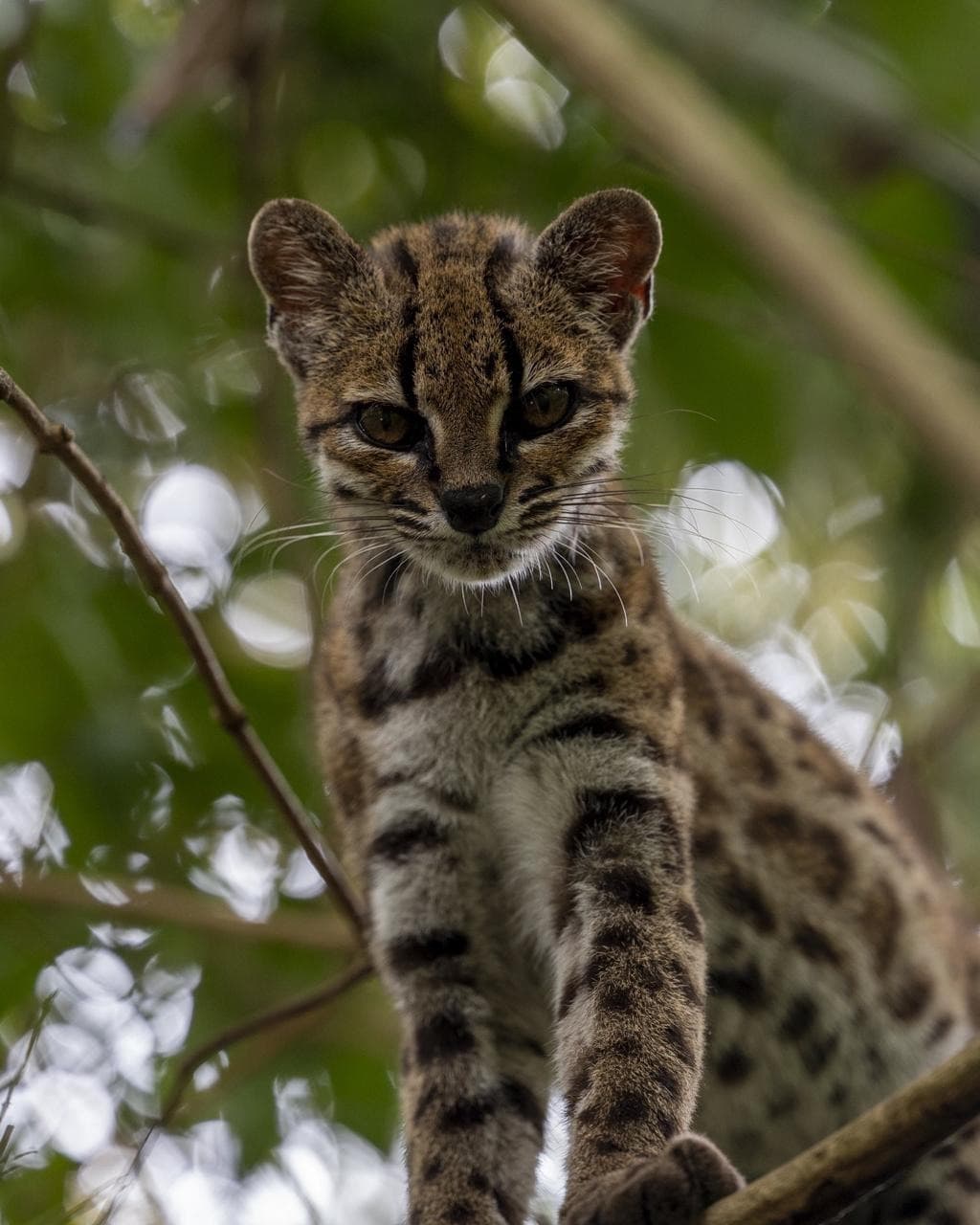
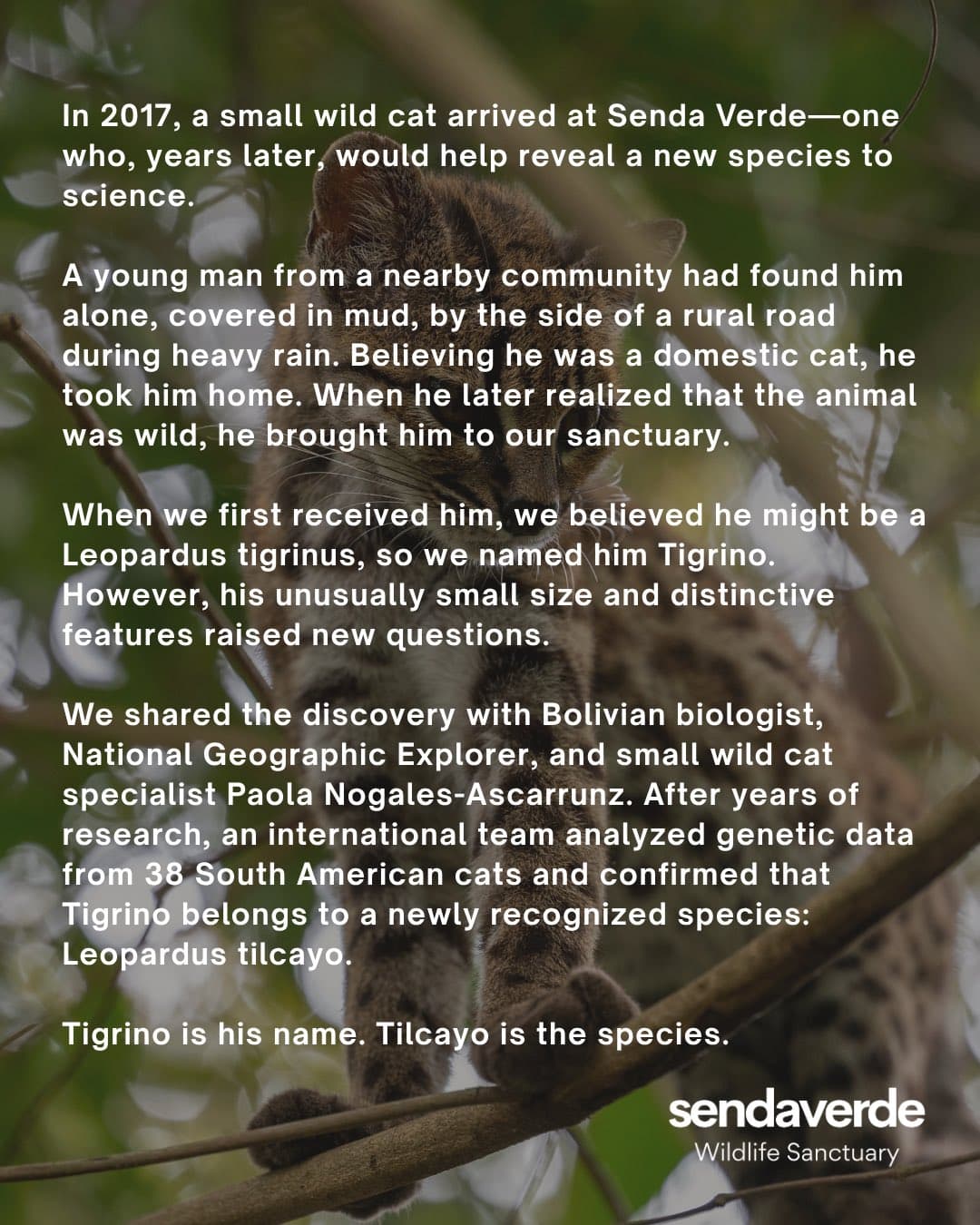
Almost ten years ago a small spotted wild cat was brought to Senda Verde. He had been taken from the forest as a kitten and kept in a household for about a year, fed food that did not meet the needs of his species. Whatever the original intention, he was kept as a pet, and by the time he arrived, returning him to the wild was no longer possible. His arrival was a rescue. Staff believed he might be a Leopardus tigrinus, so they named him Tigrino, and took responsibility for his care for life.
Because his size and features raised questions, the sanctuary contacted Bolivian biologist and small-cat specialist Paola Nogales-Ascarrunz. She and an international team did the research that would eventually confirm he belongs to a species new to science. The roles are distinct and equally important: Senda Verde rescued and cares for him; Paola and the researchers identified what he is.
In 2018 he moved into a purpose-built six-metre enclosure. In 2019 she noticed his rosettes matched nothing in the field guides. It took until September 2026, and 38 sequenced genomes, for Leopardus tilcayo to be formally described, with Tigrino as the holotype: the one animal the species is defined by, and the only confirmed living tilcayo.
He is about ten years old, three pounds, and according to the people who feed him, mostly unbothered by all of this. In their words: his story should never be used to romanticize keeping wildlife as pets. He belongs to a wild species, and his place should have been in the forest.
04 / The money
What the community has sent.
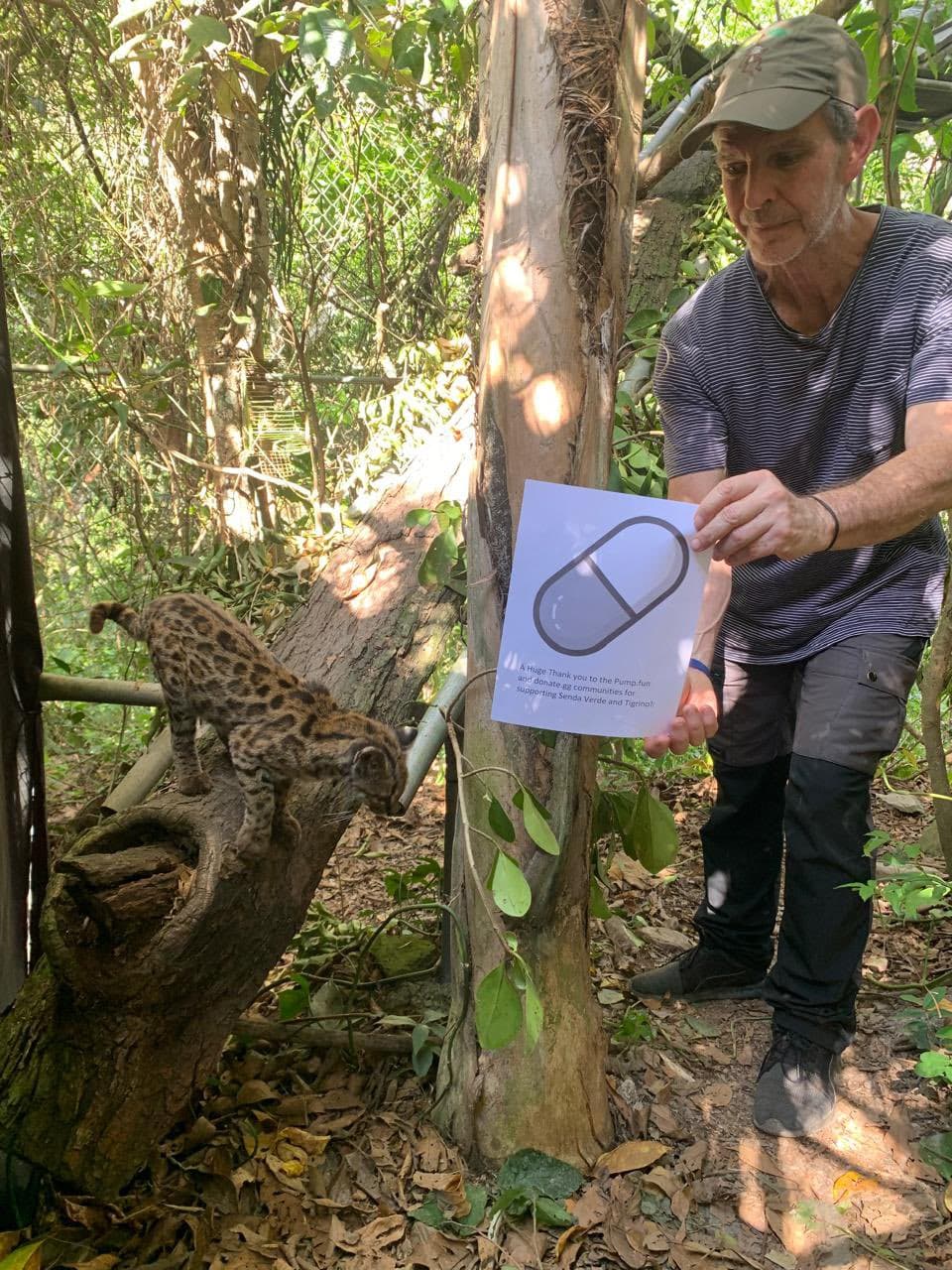
“It will help us care for Tigrino and more than 1,000 rescued animals.” Their words. When they publish what it funded, it goes here.
Delivered to La Senda Verde · Tigrino + 1,000 rescued animals
live · donate.gg$131,300
- SOL
- 1404.4
- Donations
- 123
- From $TIGRINO fees
- 96%
- Last transfer
- 5h ago
Show recent transfers
- PumpsGiving0.01 SOL5h ago
- PumpsGiving0.01 SOL6h ago
- PumpsGiving0.02 SOL9h ago
- PumpsGiving0.01 SOL18h ago
- PumpsGiving0.01 SOL20h ago
- PumpsGiving0.04 SOL21h ago
- PumpsGiving0.04 SOL22h ago
- PumpsGiving0.07 SOL23h ago
- The Stolen Monkeys0.70 SOL4d ago
- Paola Nogales Ascarrunz0.06 SOL7d ago
- $TIGRINO creator fees1.65 SOL7d ago
- Felis Margarita0.03 SOL7d ago
05 / Help
Three ways in. None require a wallet.
Donate directly
Card, PayPal, bank transfer. Goes to the sanctuary with nothing in between.
sendaverde.org →Volunteer
They run on international volunteers. Minimum stays apply; you work with the animals.
Volunteer info →Follow and share
Their X went from 900 to 3,000 followers in two days. Every follower is a future donor.
@La_Senda_Verde →Written by the $TIGRINO community, not by La Senda Verde. Facts from sendaverde.org, the sanctuary’s public posts, and National Geographic / AP reporting. Photos and video belong to La Senda Verde.